Church of St. Barnabé
The King in YellowThe Church of St. Barnabé is presented as a small, orderly Catholic sanctuary in Paris, but its apparent safety is gradually invaded by hostile sound, impossible repetition, and a vision connected with Carcosa and the King in Yellow. The church’s decisive significance lies in this reversal: the place the narrator enters for healing becomes the boundary across which an unseen enemy reaches him, while the rituals of Christian worship continue around him almost undisturbed.
Setting and Religious Order
In the Church of St. Barnabé, vespers have ended when the clergy leave the altar and the choir-boys cross the chancel to take their places in the stalls. A Suisse in rich uniform proceeds down the south aisle, striking his staff against the stone pavement at every fourth step, and Monseigneur C—— follows him toward the pulpit. The scene is governed by ceremony, movement, and rank: the congregation reseats itself, the preacher mounts the pulpit stairs, and the organ voluntary gives way to the expectation of a sermon.
The narrator has long valued the church’s organ-playing as learned, disciplined, and marked by French taste. Its music normally expresses an intelligence that is vivid but cold, controlled rather than passionate. On this afternoon, however, the familiar order of the building is disturbed from the first chord. The church remains architecturally and socially recognizable, yet the experience within it has become qualitatively different, as though an alien presence has entered a consecrated space without being noticed by the worshippers.
The Sinister Organ and the Gallery
The disturbance comes chiefly from the great organ in the west gallery. While the chancel organ supports the beautiful choir, a heavy hand repeatedly strikes across the church with harsh, dissonant passages. The playing is not incompetent; its menace lies precisely in its force and intention. The narrator imagines that the sound is pursuing someone through a labyrinth, the pedals chasing while the manuals seem to approve, turning music into an audible hunt.
The other worshippers show no alarm. The kneeling nuns retain their devout abstraction, and the fashionable woman beside the narrator continues to look toward Monseigneur C—— as though the organ were performing an Ave Maria. This contrast isolates the narrator’s perception. The church offers no communal confirmation of what he hears, so that its public ritual becomes a background against which private terror can intensify. The organist eventually emerges from behind the pipes: a slender man in black with a face as white as his coat is dark, disappearing through a small door leading to stairs and the street.
Sermon, Apparition, and Pursuit
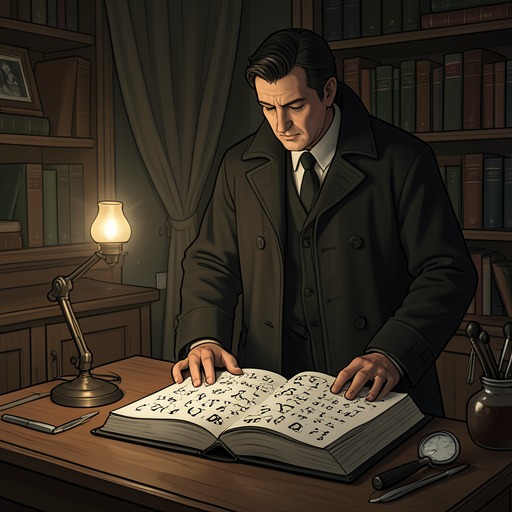
The narrator has come to the Church of St. Barnabé after three nights of physical suffering and mental trouble, hoping that the service will restore his mind. He has been reading The King in Yellow, and the church’s promise of calm is therefore placed against an already heightened state of vulnerability. When Monseigneur C—— begins his sermon, the narrator briefly believes that relief has arrived. The preacher speaks of the soul’s having nothing to fear and of the impossibility of anything truly harming it.
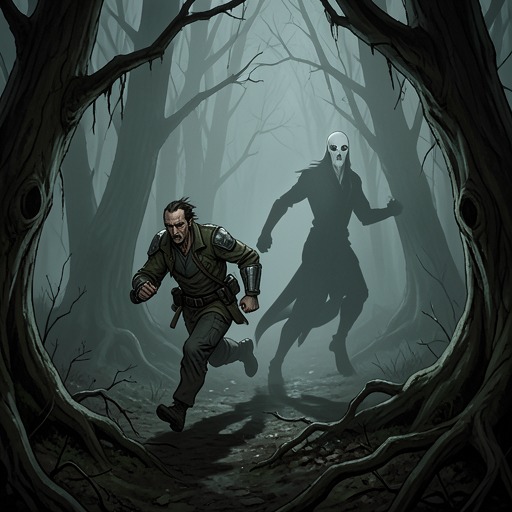
That consolation collapses when the narrator sees the same white-faced organist passing along the gallery a second time. Less than a minute has elapsed, and the man could not have returned without being seen. The impossible recurrence transforms an unsettling musician into an apparition. When he reaches the point opposite the narrator, he fixes him with an intense and deadly look of hatred before vanishing through the same door. The church’s spatial logic has failed: the gallery no longer connects places in a reliable sequence, and the enemy can appear where ordinary time says he cannot be.
The congregation’s departure makes the scene stranger rather than safer. Chairs scrape, the people rise, the nuns make their reverence, and the Suisse’s staff again precedes Monseigneur C—— toward the sacristy. The narrator remains among the leisurely moving crowd, acutely conscious of every small motion. He later understands that he had slept through the sermon, or at least cannot determine whether he slept, and that his body stayed in the cheerful church while another part of him experienced a separate ordeal.
Threshold Between Church and Carcosa
The church becomes the apparent refuge from a pursuit taking place in the Court of the Dragon. The narrator recognizes the white-faced man as someone whom death and the abode of lost souls have changed for other eyes but not for his own. While his body sits safely inside St. Barnabé, he believes that the man has been hunting his soul elsewhere. The building thus functions as a double space: an ordinary public interior and a threshold opening onto a supernatural geography.
At the moment of escape, the organ breaks out overhead and a dazzling light fills the church. The altar, people, arches, and vaulted roof disappear from the narrator’s sight. In their place come black stars, wet winds from Lake Hali, the moon dripping with spray, and the towers of Carcosa rising beyond it. The sanctuary does not simply contain a vision; its visible structure is erased and replaced by the landscape associated with the narrator’s terror. The church’s sacred architecture is therefore unable to seal out the other world.
The final transformation is both auditory and spiritual. The hostile voice rises through the flaring light as the narrator falls, and the King in Yellow whispers the words, "It is a fearful thing to fall into the hands of the living God!" The sentence turns Christian language into the climax of an uncanny assault. St. Barnabé begins as a place sought for healing and ends as the stage on which religious reassurance, supernatural dread, and the instability of perception become inseparable.